
Search
By Christine Murray, Director of Marketing, Women’s Health Division, FUJIFILM Healthcare Americas Corporation
Breast cancer remains one of the most common cancers affecting women, with about 1 in 8 women in the United States expected to be diagnosed with breast cancer during their lifetime. These statistics underscore that early detection is as critical as ever. At the same time, radiology departments are navigating workforce shortages, increasing imaging volumes, and the added complexity of interpreting mammograms for women with dense breast tissue. Patients also expect greater convenience, faster results, and seamless care—regardless of where they receive their imaging.
Meeting these demands requires an imaging ecosystem that helps radiologists work efficiently, supports diagnostic confidence, and expands access to specialized breast imaging expertise.

Dr. Yang, past President of the University Radiology Group (URG), has experienced firsthand how advances in breast imaging technology are helping address these challenges. We recently sat down with him to get his perspective on the important principles that are shaping the future of women’s imaging.
Image Quality Remains the Foundation of Early Detection
The most sophisticated workflow or artificial intelligence solution cannot compensate for poor image quality. Detecting subtle abnormalities begins with images that allow radiologists to confidently distinguish normal anatomy from potential findings.
According to Dr. Yang, image quality has been one of the most significant advantages of Fujifilm’s ASPIRE Cristalle 3D mammography system. He points to excellent separation of glandular tissue, fewer imaging artifacts, consistent performance, and improved visualization of dense breast tissue—all of which contribute to greater confidence during interpretation.
These capabilities are especially important because nearly half of women have dense breast tissue, which can make cancers more difficult to detect using conventional mammography alone. When imaging systems provide exceptional visualization while minimizing distractions caused by artifacts, radiologists can spend more time focusing on what matters most: identifying subtle findings that could lead to earlier diagnosis.
As breast imaging continues to evolve, image quality remains the cornerstone upon which every other advancement is built.
Women’s Access Shouldn’t Depend on Geography
Geography shouldn’t determine whether a woman has access to specialized breast imaging expertise. With the right enterprise imaging solutions, radiologists can securely read exams from virtually anywhere, allowing specialists to support patients and clinicians across multiple hospitals, imaging centers, and outpatient locations.
As Dr. Yang explains: “Because of our structure and the way we use Fujifilm Synapse®, at any one moment, any radiologist within our organization may be reading remotely. Some of our radiologists are in Japan. Some of them are in Israel. But even those in New Jersey may be reading an exam from a different hospital or a different one of our sites at any one moment.”
This model allows health systems to use their specialist resources more effectively. A breast imaging radiologist does not need to be physically located at every facility to provide expertise, and organizations do not need to equip each site with an expensive, dedicated workstation. Instead, specialists can support multiple facilities from wherever they are reading, helping extend subspecialty coverage across the enterprise.
For patients, this means the imaging center they visit does not have to limit the expertise available to them. Whether a woman receives her exam at a community location, outpatient center, or hospital, her images can be made available to the appropriate specialist for interpretation.
Ultimately, women deserve access to subspecialty breast imaging expertise regardless of geography or which imaging center they visit. By enabling radiologists to read from anywhere and support multiple facilities, enterprise imaging can help make that access more consistent across a health system.
AI Works Best When It Supports Clinical Expertise
Artificial intelligence continues to reshape conversations around breast imaging, but its greatest value isn’t replacing radiologists—it’s helping them make even more informed decisions.
As Dr. Yang explains, AI has become an important clinical support tool by helping identify subtle findings, prioritize potentially suspicious cases, and provide additional confidence during interpretation. These insights are integrated directly into the radiologist’s existing workflow rather than creating additional steps or separate systems to navigate.
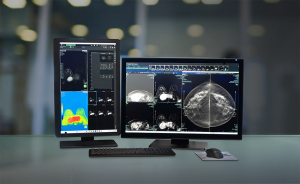
When AI is thoughtfully incorporated into the reading environment, it becomes another source of clinical information that complements—not competes with—the radiologist’s expertise.
This approach allows clinicians to remain firmly in control of patient care while benefiting from technology that can improve efficiency, reduce cognitive burden, and help ensure important findings receive timely attention.
Fujifilm’s Synapse Mammography PACS helps integrate AI into the breast imaging workflow by bringing AI results directly into the radiologist’s reading environment. Rather than requiring radiologists to open separate software or move between multiple workstations, AI findings can be presented alongside mammography images within the PACS. This allows radiologists to review AI-generated insights as an additional source of information while maintaining full control over the final clinical interpretation. The result is a more streamlined workflow that supports efficiency, consistency, and informed decision-making.
The future of breast imaging isn’t about replacing clinical judgment. It’s about enhancing it.
Building a Breast Imaging Strategy for the Future
Healthcare organizations today are making technology decisions that will shape patient care for years to come. As imaging volumes grow and AI continues to evolve, flexibility becomes just as important as performance.
Another aspect of Synapse Mammography PACS that Dr. Yang particularly values is its open architecture. The platform can integrate best-in-class AI applications regardless of which vendor developed the imaging algorithms or even which imaging equipment produced the studies.
That flexibility gives healthcare organizations the ability to adopt new innovations as they emerge without being locked into a single technology ecosystem.
For healthcare leaders, this represents more than a technology decision. It is an investment strategy—one that prioritizes interoperability, scalability, and the freedom to incorporate future advancements as breast imaging continues to evolve.
Advancing Women’s Health Together
Improving women’s health requires more than acquiring the latest mammography system or implementing new software. It requires creating an environment where radiologists have the tools they need to deliver accurate diagnoses efficiently – no matter where they are located, healthcare organizations can adapt to changing clinical demands, and women receive timely access to high-quality care.
As Dr. Yang’s experience demonstrates, advancements in mammography and enterprise imaging are helping make that vision a reality. By combining advanced mammography technology with flexible enterprise imaging solutions, healthcare organizations can strengthen diagnostic confidence, enabling radiologists to read from anywhere and support multiple facilities, and continue moving breast cancer detection forward, helping ensure more women receive the care they need, when they need it.
Fujifilm offers a comprehensive portfolio of Women’s Imaging solutions. Learn more by clicking here.